Long read · 17 min
Luggage transfer on the Camino: every carrier, route by route

You can walk every major Camino route with a day pack while a van takes your bag to the next bed. Here is who actually does it, where, for how much and under what rules — taken from the carriers' own websites, not from hearsay.
Sending your bag ahead is the best-known secret of the Camino and one of the worst documented. Everyone has heard a price from someone at dinner; almost nobody has read the terms. Lists of companies get copied from blog to blog for years, long after some of the websites on them have stopped loading.
This guide does one thing: it reports what each carrier says about itself. Every company named below is real and was checked on its own website, or on an official page, on 1 October 2026. Where a carrier prints no price list, the guide says so instead of guessing. Where a price comes from a booking form rather than a printed tariff, it says that too.
It covers who carries bags on which route, what they charge, what they will and will not take, and what happens when something goes wrong.
The short version
It exists on every busy route. The whole Camino Francés, the Portugués from Porto (and, with fewer carriers, from Lisbon), the Norte, the Primitivo, the Inglés, Fisterra and Muxía, the last stretch of the Sanabrés and the Le Puy route in France all have at least one carrier you can book online.
It costs single-digit euros a day. The prices carriers were publishing in October 2026 ran from €4 to €10 per bag per stage on the Francés, €7 to €10 from Porto, €5 to €12 on the other Spanish routes and €9.80 on the Le Puy route.
The routine is the same everywhere. Book by the evening before, tag the bag, leave it at reception by 8:00, find it at your next accommodation in the afternoon.
The limit is usually 15 kg. Carriers publish anything from 13 kg in France to 23 kg, and none of them wants things strapped to the outside.
It does not cost you the Compostela. The Pilgrim's Office lists its conditions, and carrying your own pack is not one of them. The restriction you will actually meet is practical: the carriers themselves say that public albergues do not accept delivered bags.
On the quiet routes it thins out fast. South of Salamanca on the Vía de la Plata, on the Aragonés, the Salvador and the Lebaniego, and on most French routes other than Le Puy, you are down to a phone number or nothing.
Now the long version.
How it works
The model barely changes from one carrier to the next. You book the next day's transfer by the evening before: the cut-off is 20:00 at Correos, Pilbeo and Tuitrans, and 21:00 at Caminofácil. You attach a label. Correos and Jacotrans e-mail one after an online booking, Pilbeo issues a printable card for each bag, and La Malle Postale in France accepts a plain sheet of paper with your name and mobile number on it.
The old walk-up system still exists too. Jacotrans leaves envelopes at accommodations: you write your name and destination on one, put the money inside and leave it with the bag. TaxiCamino on the Primitivo works the same way. Correos also has an envelope, but only to identify the bag — it has not accepted cash anywhere except at a post office since 2021.
In the morning the bag goes to reception, or wherever the host tells you, by 8:00. Nobody needs to be there when the van comes. Delivery is promised by 14:00 at Caminofácil, by 14:30 at Jacotrans, Pilbeo and Top Santiago, by 15:00 at Tuitrans and TaxiCamino, and by 18:00 on the Le Puy route in France. Correos says 14:30 on its website and 15:00 in its terms.
What they will not take
Fifteen kilos is the commonest ceiling: Correos, Jacotrans, Xacotrans, Tuitrans and Express Bourricot all publish it. Caminofácil and TaxiCamino allow 18 kg, Pilbeo and Top Santiago 20 kg, Luggage Driver 23 kg. In France the limit drops to 13 kg at La Malle Postale and Les Valises de Saint-Jacques. If you change carrier at the border, pack for the lower number.
Almost every carrier refuses, or refuses to answer for, anything tied to the outside of the bag — Correos names boots, sleeping bags and mats specifically. And they all say the same thing about contents in different words: money, documents, jewellery and electronics are not covered. Keep them in the day pack.
If something goes wrong
Compensation is fixed and low. Correos pays €60 for a lost bag and €30 for a damaged one. Jacotrans and Tuitrans guarantee €50 for a bag lost or stolen in transport; TaxiCamino insures each bag for €50. Caminofácil sells an optional guarantee of up to €500 for loss and €150 for breakage. Pilbeo and La Malle Postale publish no figure.
Every set of terms covers the bag only while it is in the carrier's hands — not while it waits at reception before the van arrives or after it has gone. And the claim windows are short: 24 hours at Correos, 12 hours after delivery at Tuitrans. Photograph the bag before you hand it over.
What it costs
Per bag, per stage, the prices published in October 2026 ran from €4 to €10 on the Camino Francés, €7 to €10 on the Portugués from Porto, €5 to €12 on the other Spanish routes and €9.80 on the Le Puy route. A stage means a normal walking day — up to 25 km at Correos, up to 30 km at Pilbeo and Caminofácil — and longer days are charged as two.
Booking several days at once is cheaper than paying day by day. A few whole-route totals show the real scale of it:
Sarria to Santiago, five stages: €30 at Correos, Pilbeo and Camino Cómodo; €20 at Xacotrans.
Roncesvalles to Santiago: €219 at Pilbeo (32 stages); €240.50 at Correos (30 stages).
Porto to Santiago: on the Central route €84 at Pilbeo and €90 at Correos; on the Coastal route €94 and €104.
Tui to Santiago: €42 at both Pilbeo and Correos.
Oviedo to Santiago on the Primitivo: €70 at TaxiCamino, €95 at BackPackCars, €98 at Correos, €100 at Pilbeo.
Ferrol to Santiago on the Inglés: €35 at Correos, Pilbeo and Camino Cómodo.
Irún to Santiago on the Norte: €292.50 at Correos (35 stages).
Two caveats. Correos and Jacotrans, the two best-known carriers on the Francés, print no tariff at all: their prices exist only inside the booking form. Every Correos and Jacotrans figure in this guide is what that form returned on 1 October 2026 for a walk starting on 5 October. And several smaller carriers show prices on pages with no year on them. Treat every number here as a guide and your booking confirmation as the price.
Camino Francés
The Francés has the densest offer of any route. Three carriers sell the whole way from Saint-Jean-Pied-de-Port to Santiago, two more start at Roncesvalles, several cover only Galicia, and one French company handles the crossing of the Pyrenees.
Correos (Paq Mochila)
Correos, the Spanish post office, runs the best-known service. In 2026 it operated from 16 March to 31 October on the Francés from Roncesvalles; from 1 November only Sarria to Santiago remains. It cannot start in Saint-Jean-Pied-de-Port, because Correos works only in Spain.
Price: Correos prints no tariff. Its own FAQ gives one figure — Sarria to Santiago costs €30 in total — and says discounts apply from five stages. On 1 October 2026 its booking form quoted €7 for a single stage on the Sarria–Santiago section, €10 for a single stage elsewhere (Roncesvalles–Zubiri), €51 for the six stages from Roncesvalles to Logroño and €240.50 for the whole way from Roncesvalles.
Rules: 15 kg per bag, which can be a backpack or a cabin-size suitcase. Booking closes at 20:00 the day before. The bag must be at reception before 8:00. Payment is by card or PayPal, or at any post office.
Where: any accommodation with a reception open in the morning or an access code for the driver. The exception, in Correos's own words, is public hostels, which do not allow the service even when they have a reception. If your accommodation refuses the bag, the terms say it goes back to where it came from, without a refund.
Jacotrans
Jacotrans has been on the Francés since 2006 and covers it from Saint-Jean-Pied-de-Port or Roncesvalles to Santiago. It says it works all year.
Price: there is no price list; the FAQ asks you to request a quote by e-mail, because the rate depends on the dates. On 1 October 2026 its online booking form quoted €7 for single stages such as Saint-Jean–Roncesvalles, Roncesvalles–Zubiri and Sarria–Portomarín.
Rules: 15 kg per piece, bags ready at 8:00, deliveries finished between 12:00 and 14:30. You can book online, by e-mail, by phone, through your accommodation, or with the envelope. A bag lost or stolen in transport is compensated with €50.
Caminofácil
Caminofácil, based in Lugo, carries bags on the whole Francés from Saint-Jean-Pied-de-Port.
Price: its price page says from €6 a stage and explains the range: €9 for a single Francés stage, down to €6 when you book many stages and bags. The page carries no year.
Rules: 18 kg, bags at reception before 8:00, delivery by 14:00, bookings and changes until 21:00 the day before. If the accommodation will not take the bag, it goes to one of the company's storage points and you are told where.
Pilbeo
Pilbeo, from Negreira in Galicia, is a booking platform that works with local carriers, and the only whole-route seller whose tariff page is headed with the season it applies to: 2026.
Price: €7 for a single stage; Sarria–Santiago €30, León–Santiago €86, Roncesvalles–Santiago €219.
Rules: 20 kg, next-day bookings close at 20:00, delivery before 14:30. No cash: card, PayPal or bank transfer only. Where a public albergue will not take the bag, Pilbeo offers a drop point nearby.
NCS
NCS Equipajes — the initials stand for Nunca Caminaréis Solos, "you will never walk alone" — advertises the route from Roncesvalles to Santiago, with a WhatsApp contact for each section. It publishes no price list; you get an estimate inside the booking form.
Galicia only
From O Cebreiro to Santiago, local carriers undercut everyone. Xacotrans prints €4 per piece per stage, with a 15 kg limit, on a page that shows no year. BackPackCars prints €5 a stage from Sarria. Camino Cómodo sells single stages from €6 and a Sarria–Santiago pack from €30.
From Saint-Jean-Pied-de-Port
Express Bourricot, whose office is on the rue de la Citadelle in Saint-Jean, takes bags over the pass every morning: €8 per bag per day, 15 kg maximum, to Roncesvalles and on to Burguete and Espinal. In 2026 the office was open from 9 March to 16 October.
From Roncesvalles onward you need a Spanish carrier. Jacotrans, Caminofácil and Pilbeo all list Saint-Jean as a starting point; Correos starts at Roncesvalles.
One thing to know if you sleep at Orisson: the refuge's own website says that only bags brought by Donkey Service and its partner Jacotrans are handled inside. Other carriers have to hand bags over to their customers in the public area.
Camino Portugués
From Porto the choice is nearly as wide as on the Francés. From Lisbon it is not.
Correos
In 2026 Correos sold Paq Mochila from Porto on both the Central and the Coastal route, including the Variante Espiritual, from 16 March to 31 October. In winter only Tui to Santiago runs. On 1 October 2026 its form quoted €90 for Porto–Santiago on the Central route (twelve stages), €104 on the Coastal route (fourteen) and €42 for Tui–Santiago; the winter product for Tui–Santiago came to €60. Lisbon is not in its system. The rules are the same as on the Francés.
Top Santiago
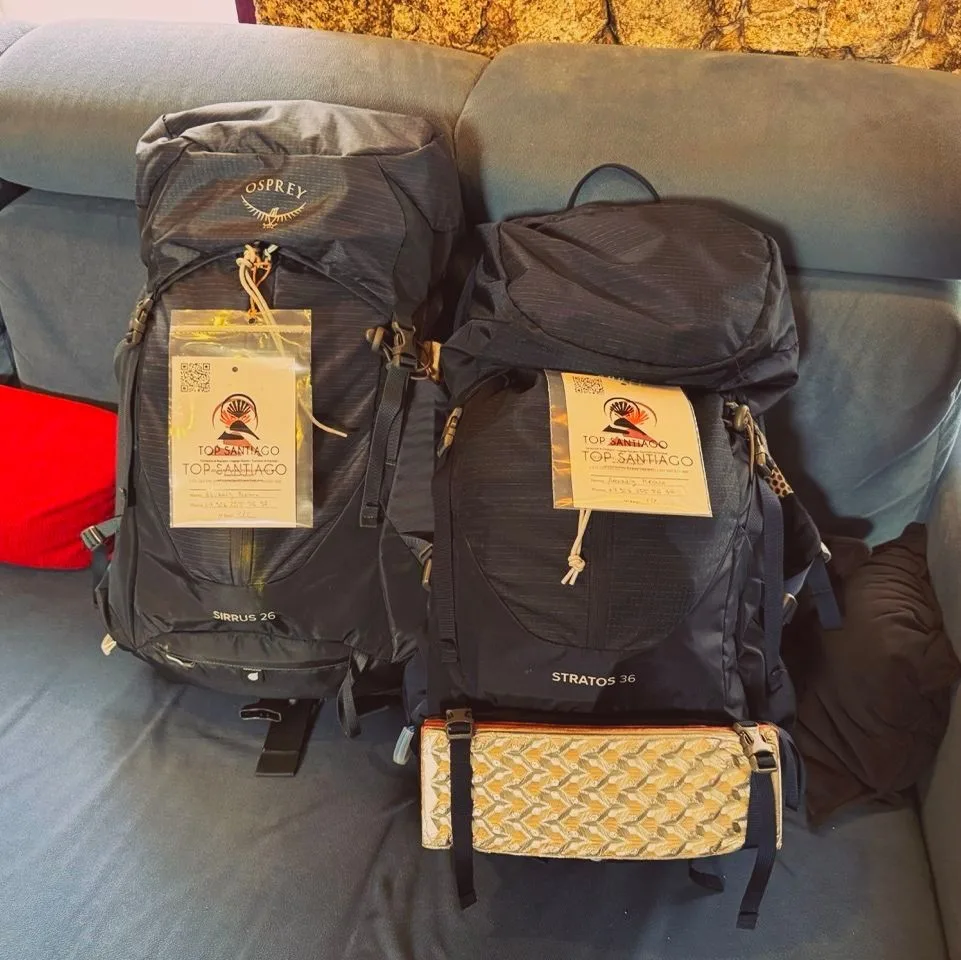
Top Santiago is the Portuguese specialist: founded in 2015, headquartered in Barcelos with branches in Porto, Viana do Castelo and Tui, and one of the few carriers that describes a service all the way from Lisbon, via Fátima and Porto. Bags up to 20 kg, collected from 8:00, delivered at 14:30, paid by card, PayPal or bank transfer. It prints no price list; the site offers a cost simulator inside the booking form instead. It is the carrier whose tags are on the two packs in the photo at the top of this page.
Pilbeo, Caminofácil and Tuitrans
Pilbeo prints 2026 prices: Porto–Santiago €84 on the Central route and €94 on the Coastal, Tui–Santiago €42, Baiona–Santiago €42. Caminofácil prints from €7 a stage on the Central and Coastal routes from Porto and on the Variante Espiritual from Pontevedra.
Tuitrans, based in Tui, covers Porto to Santiago by the traditional and the coastal route, daily from 1 April to 31 October; out of season it works only by prior reservation and at a higher cost. It publishes no prices, limits bags to 15 kg and delivers by 15:00.
From Lisbon, and for groups
Luggage Driver, a Porto company, sells packages rather than single stages, priced per group of bags: Porto–Santiago from €245 to €640 and Lisbon–Porto from €480 to €545 in 2026, with bags up to 23 kg. That arithmetic suits a group sharing the cost better than a solo walker. Between Lisbon and Porto the only other carrier found is a local taxi firm, Taxi Templários, which covers Azambuja to Coimbra by quote.
The boat day
On the Variante Espiritual the last day before Padrón is a boat up the Ría de Arousa. No carrier explains in writing what happens to the bag that day; the Correos form simply treats Vilanova de Arousa–Padrón as an ordinary stage. Ask when you book.
The northern routes and the ways around Santiago
Camino del Norte
Correos sells the whole Norte from Irún in season; its form quoted €292.50 for Irún–Santiago on 1 October 2026. Caminofácil lists the route from €12 a stage, its dearest. Express Bourricot, the Saint-Jean carrier, also advertises transfers from Irún at €12 per suitcase, 13 kg maximum.
Beyond those, the Norte is covered by a relay of small local carriers, each publishing only its own section and none publishing a price: Transvizcaya from Irún to Bilbao, TransMikel from Bilbao to Llanes, Asturperegrino from Llanes to Ribadeo, and local taxis from Ribadeo to Santiago. It works, but you arrange it one phone call at a time.
Camino Primitivo
The Primitivo has a specialist. TaxiCamino, based in La Espina in Asturias, publishes €7 a stage, €6 from four stages, and €70 for the whole way from Oviedo to Santiago; 18 kg, delivery before 15:00. Pilbeo sells the route for €100, BackPackCars for €95, Camino Cómodo from €110, and Correos covers it in season (its form quoted €98).
Camino Inglés
Correos serves the Inglés from Ferrol only. Pilbeo sells Ferrol–Santiago for €35 and a separate A Coruña–Santiago route for €30. MochiGo, a local carrier from Ferrol, covers both starting points and the continuation to Fisterra from €5.
Fisterra and Muxía
After Santiago you still have a choice: Correos in season (€32 for Santiago–Fisterra by its form), Pilbeo (€30 for the five stages Santiago–Fisterra–Muxía), Caminofácil from €6 a stage, BackPackCars at €6 a stage, Camino Cómodo and MochiGo.
Vía de la Plata and Camino Sanabrés
Here the map changes. Correos, Pilbeo, Caminofácil and the Galician carriers serve only the last stretch, from Ourense to Santiago: Pilbeo sells it for €28, Caminofácil from €7 a stage, and the Correos form quoted €55. Further south one small carrier, MochilaTrans, says it covers the Vía de la Plata from Salamanca and the Sanabrés from Granja de Moreruela, without publishing prices.
For the long southern half, from Seville to Salamanca, no stage-by-stage carrier could be found on any primary source. Plan to carry your pack.
Camino de Invierno
Pilbeo is the one carrier you can book online: €7 a stage, €91 for the route from Ponferrada. Correos lists the Invierno as available on request, but in September 2026 it told a customer in writing that it did not currently serve it. Ask before you count on it.
Aragonés, Salvador and Lebaniego
These are request-only. On the Aragonés, Correos takes bookings from Somport by e-mail. On the Salvador, Correos has said it has no service; a dedicated site, caminodelsalvador.com, offers transfers by WhatsApp without publishing prices. On the Lebaniego, the route's official foundation names a single local operator and gives a phone number.
In France: the Le Puy route
On the Via Podiensis no single carrier covers the whole line from Le Puy-en-Velay to Saint-Jean-Pied-de-Port. Somewhere in the middle you change company.
La Malle Postale
La Malle Postale, based in Le Puy, covers the route from Le Puy to Aire-sur-l'Adour. Its 2026 season ran from 1 April to 31 October. The limit is 13 kg per bag, in one soft piece — suitcases are discouraged and not covered for damage. Bags are ready at 8:00 and delivered before 18:00.
Price: its own pages show prices only inside the booking system. The Le Puy tourist office lists the service at €9.80 for 2026, and the company adds a 4% fuel surcharge to 2026 bookings.
The other three
Les Valises de Saint-Jacques takes over for the second half: Cahors to Saint-Jean-Pied-de-Port, 1 April to 31 October 2026, €9.80 per bag per stage, 13 kg. Transbagages covers only Le Puy to Conques, from €7.50 per bag per stage, on a page that shows no year.
A fourth name, Transports Claudine, appears on most lists for Figeac to Saint-Jean. The company is legally active, but its website still talks about the 2023 season and its price page no longer loads, so nothing about its current prices can be confirmed.
On the other French routes the published offer is thin. La Malle Postale carries bags on the Arles route only as far as La Salvetat-sur-Agout. The French agency for the Compostela routes lists a handful of taxis on the Vézelay and Piémont routes and nobody at all on the Tours route.
Does it cost you the Compostela?
No. The Pilgrim's Reception Office in Santiago publishes its conditions: at least 100 kilometres on foot or on horseback, or 200 by bicycle, on one recognised route, including the last stage into Santiago; a religious or spiritual motive; and a stamped credential, with two stamps a day over the final stretch. Nothing in those conditions mentions a backpack. The Office has not written that luggage transfer is fine, either — it simply does not ask.
The restriction you will actually meet is at the door of the albergue. Correos states that public hostels do not allow the service. Jacotrans names religious lodgings and public albergues as places that may not accept a delivery. Pilbeo and Tuitrans arrange a drop point nearby instead. In practice: if you send your bag, book private accommodation, or ask the carrier where it will leave the bag.
Some albergues go further. In June 2023 the twelve albergues of the Camino Francés Federación — among them the municipal albergues of Estella, Logroño, Nájera and Burgos — announced that they would stop admitting suitcases, except for specific medical reasons. Whether that is still enforced in 2026 could not be confirmed, so ask.
Suitcases, bikes and storage in Santiago
A different problem: the suitcase you will not need for a month. Correos's Paq Peregrino sends it to the main post office in Santiago, at Rúa do Franco 4, a couple of minutes from the Cathedral: €20.95 for up to 15 kg, including fifteen days' storage, on a page that gives no year for the price. From Porto there is a direct service, Paq Mochila Directo, at €50 per bag in 2026. From Saint-Jean-Pied-de-Port, Express Bourricot forwards a suitcase to Santiago for €95, up to 20 kg, storage included.
The same post office has a left-luggage desk: €4 a day for a backpack or small suitcase, €6 for a large suitcase, €7 for a bicycle, at 2026 prices. It exists partly because the Cathedral does not allow backpacks inside. A private alternative, Casa Ivar on Rúa Nova, charges a flat €35 per suitcase or backpack with up to ninety days' storage.
For bicycles, Correos's Paq Bicicleta ships a bike within mainland Spain for €50.95 in 2026, box included.
Where this comes from
Every figure in this guide was read on the carriers' own websites or on official pages — Correos, the Pilgrim's Reception Office, the Le Puy tourist office, the French agency for the Compostela routes — on 1 October 2026. Prices described as quoted by a form come from booking forms that print no tariff; they can change from one day to the next. Carriers that could not be confirmed as active, because the website was dead or had not been touched in years, were left out.
Almost every date here belongs to the 2026 season. When this was written, no carrier had published anything for 2027.